The short answer
If your electrical panel says Zinsco, Sylvania or Federal Pacific (FPE, "Stab-Lok"), call me. Get it looked at, and plan to replace it.
These two brands have a long record of trouble. Most electricians and home inspectors will tell you the same thing: they do not trust them, and they do not recommend keeping them. You do not have to panic, and I am not going to scare you. But I also would not wait for a problem to show up, because the way these panels fail is the kind you do not see coming.
What these panels are, and how to tell if you have one
Your electrical panel is the metal box, usually in a garage, basement, utility room or hallway, with a row of switches in it. Those switches are circuit breakers. Their job is to shut a circuit off when too much power is flowing, before the wiring gets hot enough to start a fire.
Two older brands are the ones I am asking you to watch for:
- Zinsco, also sold under the name Sylvania (and sometimes GTE-Sylvania). It was installed in homes roughly from the 1950s to the 1970s.
- Federal Pacific Electric, or FPE, whose breakers are called Stab-Lok. These went into a lot of homes roughly from the 1950s to the 1980s.
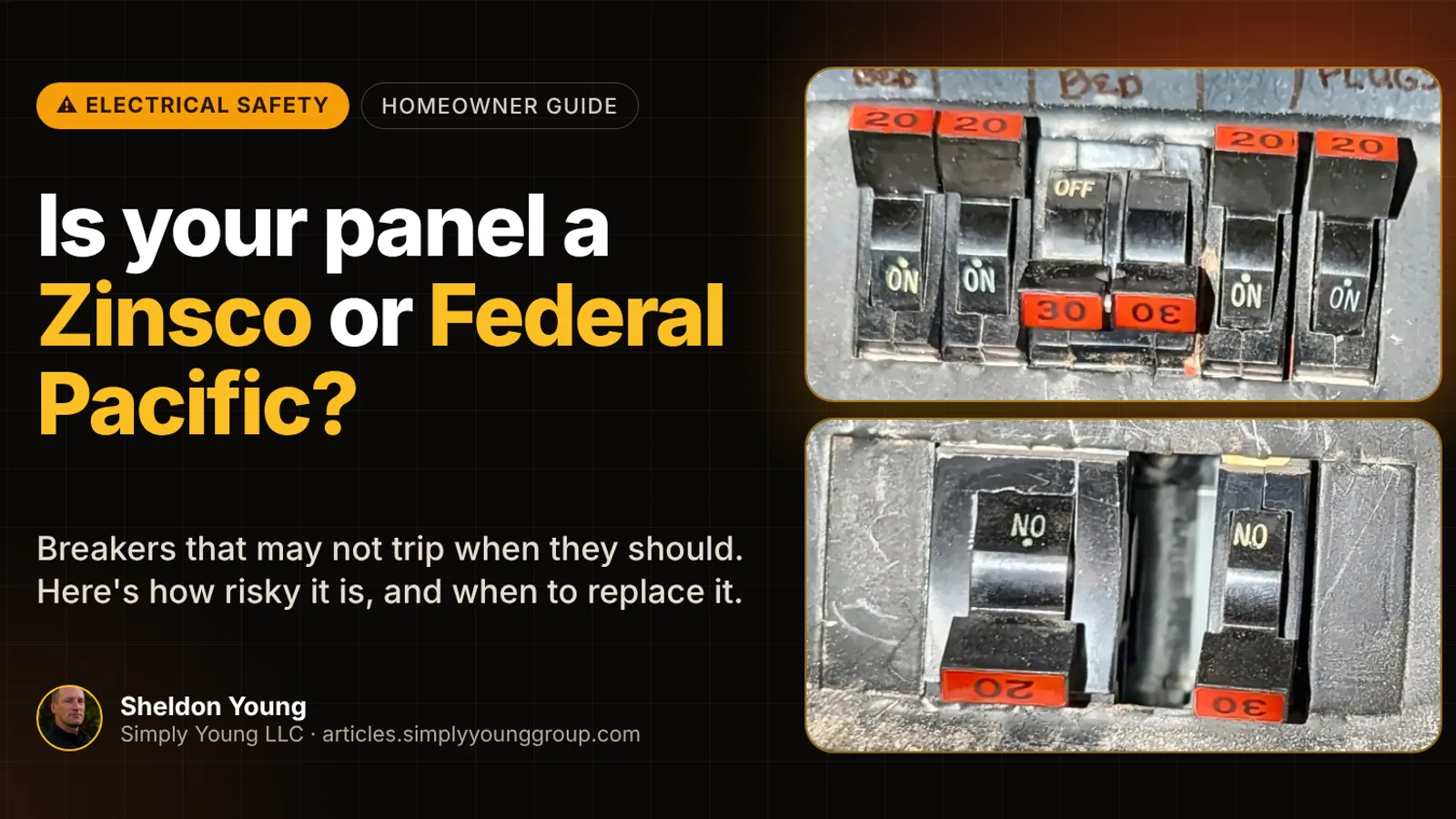
To check, look at the label on the inside of the panel door, or on the front of the panel, and at the breakers themselves. The brand name is printed there. If you see Zinsco, Sylvania, Federal Pacific, FPE, or Stab-Lok, that is the panel I mean. Do not take the cover off yourself to look. The door label is enough, and a photo of it is the best thing you can send me.
Why people worry about them
Zinsco: The concern is how the breaker connects to the metal bar inside the panel. Over time and with heat, the breaker can fuse, melting itself onto the bar. When that happens, the breaker may not shut the power off when it should, and it may look completely normal from the outside. The panel can also overheat and burn up without any warning you would notice.
Federal Pacific Stab-Lok: The concern is that the breakers may not trip when they are supposed to. A breaker that does not trip is like a smoke alarm with no battery: everything looks fine right up until it is needed.
In both cases the danger is the same: a breaker that is supposed to be your safety device may not do its job. You cannot tell by looking at it, and you cannot tell by flipping it.
Here is what is known, and what is not
I would rather be straight with you than sell you on fear.
- There was never an official recall. Neither of these brands has been formally recalled. In the early 1980s the U.S. Consumer Product Safety Commission looked into Federal Pacific, and the matter was later closed without a ruling on whether the breakers were safe. That is not the same as being cleared.
- The test results disagree. You will see very specific failure percentages online. They vary a lot from source to source, and some come from people who sell panel replacements, so I am not going to quote you a number. Some tests found serious problems. Some found the breakers worked.
- Not every one of these panels has failed. Plenty are still running. But the people whose job is to look at electrical panels, home inspectors and electricians, flag them again and again, and many will not touch them without recommending a replacement.
- You cannot test your own. A breaker that works today tells you nothing about whether it will trip on the one day it counts.
Put it together and the sensible conclusion is that this is not a risk worth keeping when the fix is known.
Warning signs to take seriously
If you have one of these panels and notice any of these, do not wait:
- A burning smell near the panel, or from an outlet or switch.
- The panel cover feels warm to the touch.
- Breakers that trip often, or will not reset.
- Lights that flicker or dim when something turns on.
- Buzzing, crackling or humming from the panel.
- Scorch marks, discoloring, or melted plastic on or near the panel.
- A breaker that is stuck and will not move.
If you smell smoke, see sparks or see flames: get everyone out and call 911. Do not try to deal with it yourself.
For anything less urgent, call me the same day.
Why it is worth replacing, not working around
A fair question is whether it is enough to swap one breaker or add a surge protector. Usually, no. Replacement breakers for these panels can be hard to find, and with Zinsco in particular, much of the worry is the panel itself, the bar the breakers connect to, not only one breaker. A newer breaker in an old panel does not fix that. Ask the electrician who looks at yours.
A new panel gets you:
- A safety device that works the way it is supposed to, in a modern, current-code panel.
- Room to grow. More circuits for an EV charger, a hot tub, a heat pump, a remodel or an addition.
- A cleaner record. A home inspector will not flag it, and a buyer will not use it as a reason to ask for a lower price.
- Peace of mind. You stop wondering about it.
Some insurance companies also ask about these panels, and some may ask you to replace one before they will cover or renew a home. Rules differ by company, so ask yours. If you are selling, expect an inspector to bring it up.
What I will do when you call
I am not going to push a job on you. When you call me, here is what I will do:
- Ask a few questions about the house, how old it is, and what the panel says.
- Have you send a photo of the label and the panel door, so I can tell what you have.
- Tell you plainly what I think and what the risk looks like for your house, including if it is not urgent.
- Explain what replacement involves. Usually a permit, sometimes the power company, and a period with the power off while the work is done.
- Bring in a licensed electrician to do the panel work and arrange the schedule, so you have one person to talk to and the work is done by someone licensed and insured. You can ask me anything along the way.
If you only want to know what to do next, that is a good enough reason to call.
What to do in the meantime
Until it is looked at:
- Do not take off the panel cover or touch what is inside. It is live, and it can kill you.
- Do not try to remove or replace a breaker yourself.
- Do not keep adding load. No new space heaters, extension cords, or power strips plugged into power strips on circuits that already trip.
- Know where the panel is, and keep it clear so you can reach it in a hurry.
- Take a photo of the label and send it to me.
- Make sure your smoke alarms work, especially near bedrooms.
What to do next
Go and look at your panel door today. If it says Zinsco, Sylvania, Federal Pacific, FPE or Stab-Lok, call me, or use the button below to request a consultation. I will tell you what I see, what I would do, and what it is likely to involve, and you can decide from there.
Sources: the home-inspection reference site InspectApedia on Zinsco panels and Federal Pacific Stab-Lok panels; NBC Bay Area's report, Federal Pacific Circuit Breakers: Investigation Finds Decades of Danger; and the City of Lawndale's notice on electrical panel recalls.