The short answer
Clean the lint screen after every load. Clean the vent itself, the duct that runs from the back of the dryer to the outside, at least once a year. If you do a lot of laundry, have pets, or the vent run is long or has several bends, do it more often.
Most people only do the first half. The lint screen is right there, so it gets cleaned. The vent is behind the dryer, inside a wall, and out of sight, so it does not. That gap is the reason this article exists.
Do people really skip it?
Mostly, yes. The U.S. Consumer Product Safety Commission has noted that people usually clean the lint filter, but typically do not clean the ducting or the inside of the dryer cabinet.
You can see the result in the fire statistics. The National Fire Protection Association (NFPA) estimates that U.S. fire departments responded to about 15,970 home fires per year involving clothes dryers or washing machines in 2010 through 2014, and dryers were behind 92% of them. Those fires caused an estimated:
- 13 civilian deaths a year
- 440 civilian injuries a year
- $238 million in direct property damage a year
The leading cause, at 31%, was simply failure to clean. Not a defective machine, not a freak accident. Lint that nobody removed.
Those figures are a few years old now, and different studies count differently, so treat them as the size of the problem, not as a precise number for this year. The pattern is the same in every source I found: lint is what burns.
Why a vent clogs when you clean the screen every time
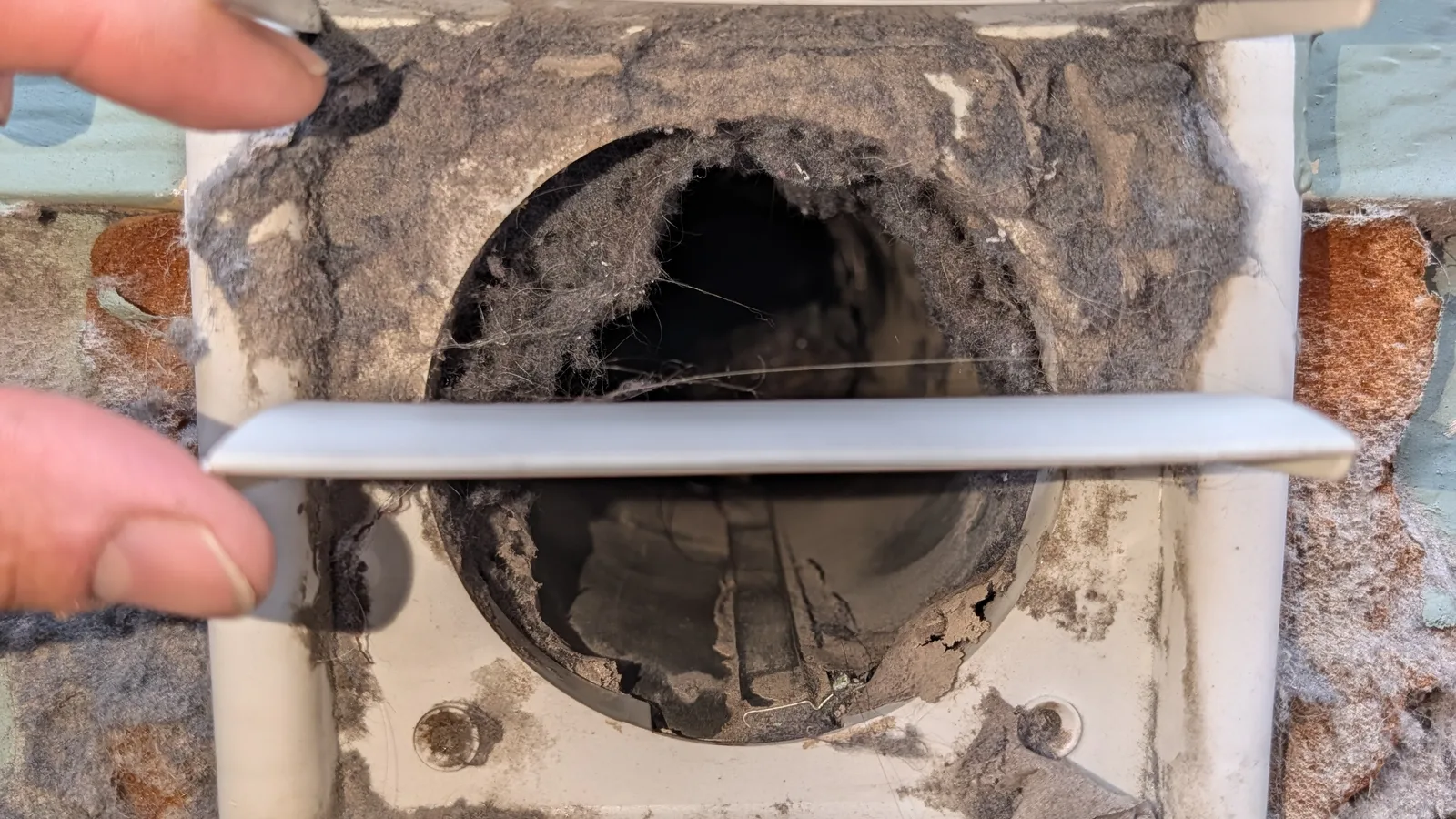
The lint screen catches most of the lint, not all of it. The rest is carried out with the hot, damp air and settles in the duct. A little at a time, it builds up on the walls of the pipe, and any rough spot, bend or sagging section catches more.
A few things make it worse:
- A long run. The farther the air has to travel, the more lint drops out along the way and the harder the dryer has to push.
- Lots of bends. Every elbow slows the air and gives lint a place to stack up.
- Flexible foil or plastic duct. The ridges inside the accordion-style pipe catch lint, and it can sag and crush. Building codes based on the International Residential Code call for rigid metal duct with a smooth inside for the hidden part of the run, with a short flexible connector allowed only right at the dryer.
- A clogged or stuck exterior cap. The flap on the outside wall can get packed with lint, jammed, or covered by something else.
- Dryer sheets and softener residue. Over time they can leave a film on the lint screen that blocks airflow even when the screen looks clean.
On length: the model code sets a maximum for the duct, and each bend takes some of that length away. The exact numbers differ by code edition and by what your dryer's installation manual says, so check yours instead of trusting a number from an article.
Signs your vent is already partly blocked
You do not have to wait for a fire to know something is wrong. Look for these:
- Clothes need more than one cycle to dry, or you keep adding "more time."
- The clothes, or the outside of the dryer, feel hotter than they used to.
- The laundry room feels humid or smells musty after a load.
- A burning or hot-lint smell.
- Lint around the outside vent, or little air coming out when the dryer runs.
- The flap on the outside vent barely moves, or does not open at all.
- The dryer shuts off before the cycle is done.
Any one of these is a reason to check the vent. More than one is a reason to check it today.
How much does cleaning it actually help?
Here is the honest answer, because there are a lot of confident numbers online that I could not back up.
Better airflow is widely reported to shorten drying time. That makes sense: the dryer's job is to move hot air through wet clothes and push the moisture outside. When the exhaust is restricted, the damp air has nowhere to go, so the clothes stay damp and the dryer keeps running. A dryer that needs two cycles to dry one load is running about twice as long as it should.
What I could not find is a solid, measured figure for how much electricity or gas a clean vent saves. A U.S. Department of Energy training document on dryer venting says reduced drying time is commonly cited as a benefit, but its author found that the agencies and manufacturers they asked had no measured data on energy savings. So you will not see a percentage here.
What you can count on:
- Shorter cycles. Less time running means less heat produced and less gas or electricity used.
- Less wear. A dryer that runs long, hot cycles works its heating element and motor harder.
- Lower fire risk. This is the one with real numbers behind it.
You can measure your own result. Time how long a typical load takes now. Clean the vent. Time the same kind of load again. If the second number is clearly shorter, that is your answer.
Check it yourself in about ten minutes
You can look at your own vent without any special tools. This is the basic version:
- Turn the dryer off and unplug it. If it is a gas dryer, do not move it or disconnect anything. A gas dryer is connected to a gas line, and its exhaust also carries combustion gases, so a blocked vent is more serious. Leave gas dryers to a professional.
- Pull the dryer out far enough to reach the back. Go slowly so you do not kink the duct or strain the cord.
- Look at the duct. Is it rigid metal or flexible foil? Is it crushed, sagging, or disconnected anywhere?
- Loosen the clamp and slip the duct off the back of the dryer. Look inside. A thin coating is normal. A thick mat of lint is not.
- Clear what you can reach. A vacuum with a long hose attachment, or a dryer vent brush kit, works for the first few feet.
- Go outside and check the vent cap. Remove lint from the flap and make sure it opens freely.
- Put it all back, plug the dryer in, and run it empty for ten minutes. Hold your hand at the outside vent. You should feel strong, steady, warm air. If it is weak, there is still a blockage somewhere in the line.
If you can only reach part of the run, or the airflow is still weak at the end, the blockage is farther in than you can safely get to.
When to have a professional do it
Call someone when:
- The vent is long, goes up through a second floor, or comes out on the roof.
- The duct is flexible foil or plastic and should be replaced with rigid metal.
- You have a gas dryer.
- You did the steps above and the airflow is still weak.
- You are not comfortable pulling the dryer out and taking the duct apart.
A proper cleaning clears the whole line from the dryer to the exterior cap, not just the first few feet, and then confirms the air is actually moving at the outside vent. That is what our dryer vent cleaning does: the full vent line is cleared, lint is removed at the dryer and at the exterior vent, the dryer is run to confirm air moves freely, and the exterior cap is inspected.
Habits that keep it from building up again
- Empty the lint screen after every load. Make it automatic, like closing the door.
- Wash the lint screen now and then. If water beads up on it instead of soaking in, it has a film. A little warm soapy water and a soft brush clears it.
- Do not overload the dryer. Clothes need room for air to move through them.
- Vent to the outside. Never into a garage, crawl space, attic or the house.
- Keep the outside vent clear. In North Idaho that can mean digging snow away from a low vent in winter, and checking for a bird's nest in spring.
- Use rigid metal duct where you can, with as few bends and as short a run as the layout allows.
- Do not run the dryer when you are asleep or away from home. Fire-safety guidance, including NFPA's, says to stay in the house while it runs.
- Never dry items that have had flammable liquids on them, such as gasoline, cooking oil or cleaning solvents. They can ignite in the dryer.
What to do next
If your clothes take two cycles, if it has been more than a year, or if you have never had the vent cleaned, start with the ten-minute check above. If you would rather not take the dryer apart, request a consultation below and we will clear the line and make sure the air is moving the way it should.
Sources: the NFPA's Clothes Dryers and Washing Machines Fact Sheet, as published by the U.S. Department of Energy; the U.S. Department of Energy's dryer venting guide.